State license required
Illinois: help with roof, insulation and solar work
Roofers need a state license, weatherization help is confirmed, and two rules we could not read are flagged below instead of guessed.
By RoofElm Editorial Team Updated 5 min read
- State roofer license
- License required
- Weatherization help
- Income up to 200% FPL
- Climate zones
- IECC 4A and 5A
- Attic target, no insulation
- R-60 in both zones
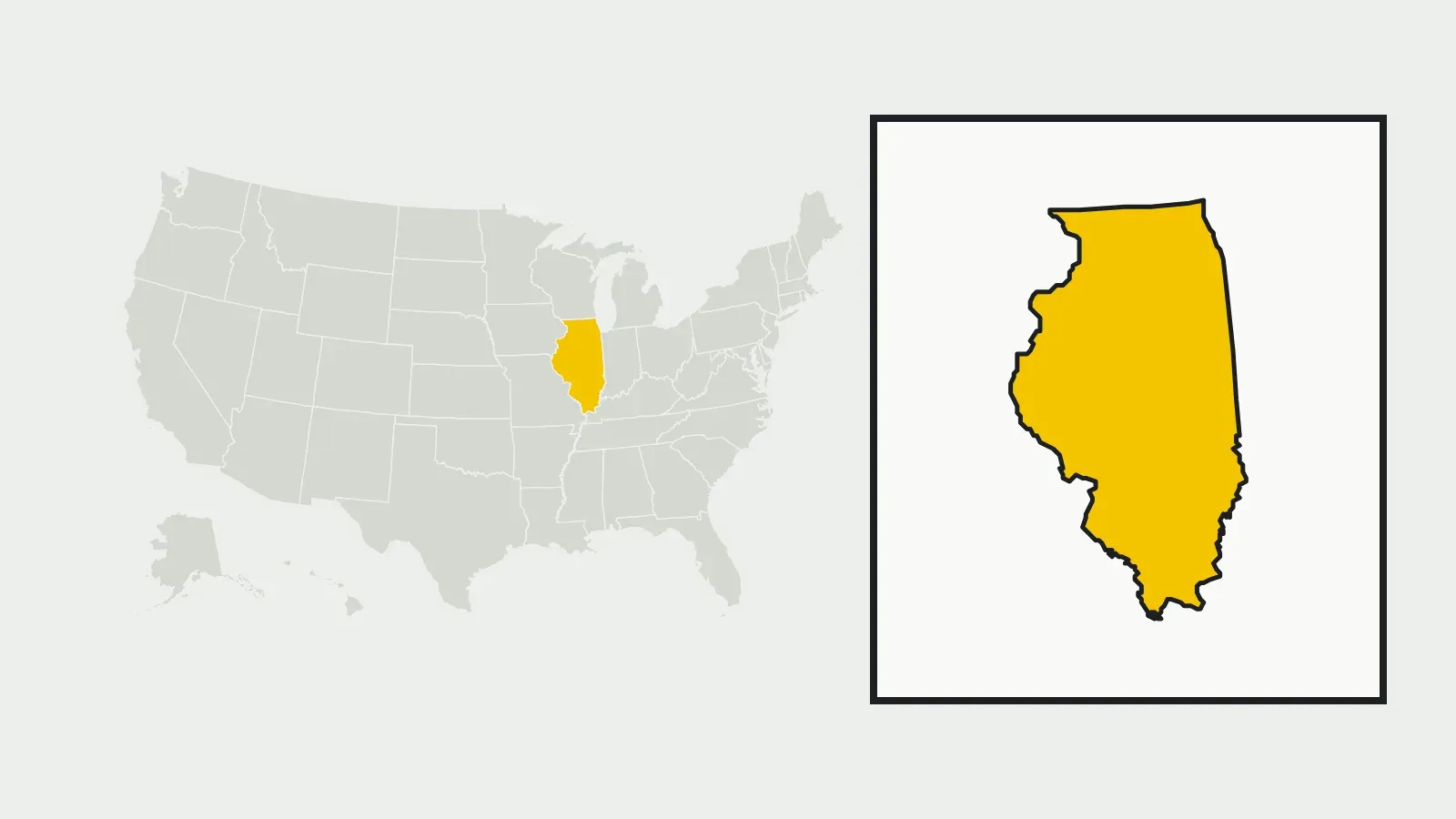
In short
Households at or below 200% of the federal poverty level can apply for weatherization through the Illinois Home Weatherization Assistance Program, which the Department of Commerce and Economic Opportunity (DCEO) runs. Apply online, at a local Community Action Agency, or by phone. Illinois requires roofing contractors to hold a state license from the Department of Financial and Professional Regulation (IDFPR). We could not confirm the status of its home energy rebates or its solar property tax treatment, so those sections say how to check.
Illinois at a glance
Hiring a roofer in Illinois
Illinois licenses roofers at the state level. Under the Illinois Roofing Industry Licensing Act (225 ILCS 335, section 9), it is unlawful to run a roofing business without a license from IDFPR, and roofing work of any kind, from building to repair, may be done only by a licensed roofing contractor or a qualifying party. A company that sells roofing may subcontract the work only to licensed roofing contractors. We did not review the Act's other exemptions.
IDFPR's consumer brochure says licensed roofers must show their license number on contracts, bids and building permit applications, and that a roofer may not lend a license to someone else. It describes limited licenses for residential work and unlimited licenses that also cover commercial and industrial work. Ask which one the roofer holds. The guide to hiring a contractor has the full question list, and the roof replacement project page shows what a good estimate contains.
- Ask the roofer for the Illinois roofing license number, then confirm it with IDFPR before you sign.
- Ask your city or county building office whether a roof replacement needs a permit and who pulls it.
- Ask for a certificate of insurance sent by the insurer, not a photocopy from the roofer.
- Get written estimates that name the shingle line, the underlayment and the flashing, and hold the final payment until cleanup and any permit sign-off.
Weatherization help for lower incomes
DCEO runs the Illinois Home Weatherization Assistance Program, which makes homes more energy efficient and adds health and safety upgrades for lower-income households. Your combined household income must be at or below 200% of the federal poverty level, and the limit rises with household size. Use the current table on the DCEO page rather than a number from an old article.
You can also qualify automatically through categorical eligibility, such as receiving energy bill assistance (LIHEAP) in the last 12 months, receiving certain cash assistance in the prior 12 months, or being enrolled in certain HUD or USDA means-tested programs. See how weatherization and rebates work for what the work usually includes.
- Apply online on the DCEO weatherization page.
- Or apply in person through the Community Action Agency that serves your area.
- Or call the Help Illinois Families call center at 1-833-711-0374, or email communityassist@illinois.gov.
Home energy rebates: not confirmed
The federal HOMES (whole-home) and HEAR (appliance and electrification) rebates are run by each state. The DCEO weatherization pages we read on November 19, 2026 do not mention them, and we did not open a state page that states their status, so we have not confirmed whether Illinois's rebates are open, who qualifies or when they launched.
Do not sign a contract because of an Illinois rebate until the state's own page lists the program, its dates and its approved contractors. We post changes on the rule changes page.
Solar and property tax
We could not confirm how Illinois treats the value a rooftop solar system adds to your home for property tax. We could not read the Illinois property tax rules on solar systems. Ask your county assessor whether the system will raise your assessment, and get the answer in writing before you sign.
The federal 25D tax credit for rooftop solar ended for systems placed in service after December 31, 2025, so do not count on it for a 2026 install. Compare a quote against your own electric rate with the solar payback calculator, and read the rooftop solar project page first.
Insulation targets in Illinois climate zones
A DOE Building America guide puts 38 southern Illinois counties in IECC zone 4A, including Madison, St. Clair, Jackson and Williamson, and the rest of the state in zone 5A. That guide is the 2015 edition, so confirm your county with your building office. ENERGY STAR's retrofit table for existing homes lists R-60 for an uninsulated attic in zones 4A and 5, and R-49 where 3 to 4 inches are already there. Measure what you have with the attic insulation gap calculator.
| Illinois zone | Attic with none | Attic with 3-4 inches |
|---|---|---|
| 4A | R-60 | R-49 |
| 5A | R-60 | R-49 |
Common questions
Do I need a license to hire a roofer in Illinois?
Yes. Illinois requires roofing contractors to hold a state license from the Department of Financial and Professional Regulation. Ask for the license number, check it with IDFPR, and ask your building office about permits.
Who qualifies for weatherization in Illinois?
Households with combined income at or below 200% of the federal poverty level, or those who qualify categorically, for example through LIHEAP in the last 12 months. Apply through DCEO online, a Community Action Agency or 1-833-711-0374.
Are the Illinois HOMES and HEAR rebates open?
We could not confirm it. The DCEO weatherization pages do not mention them. Check the state's own page for dates and contractor lists before you buy anything because of a rebate.
Does a solar system raise my Illinois property tax?
We could not confirm the rule. Ask your county assessor whether the system will raise your assessment.
Sources
- Illinois General Assembly: Roofing Industry Licensing Act, 225 ILCS 335/9 (licensure requirement)
- IDFPR: Roofing contractor consumer brochure
- Illinois DCEO: Illinois Home Weatherization Assistance Program
- Illinois DCEO: Home weatherization FAQ
- U.S. Department of Energy: Building America guide to climate regions
- U.S. Department of Energy: Building America Best Practices Volume 73, climate zone guide
- ENERGY STAR: Recommended insulation levels for existing homes
Facts checked on November 19, 2026 against the pages above. The roofer license statute section was read the same day, with the IDFPR brochure (undated). The home energy rebate and solar property tax pages would not open or did not cover those topics, so those two items are not confirmed. Programs and rules change; confirm with the agency before you act.
Next on the job
-
Project
Roof replacement
Tear-off, squares, ventilation and the questions to ask before you sign a bid.
-
Guide
Hire a licensed contractor
Check the license, the insurance and the permit plan before you sign. Licensing is state law.
-
Guide
How energy rebates and weatherization work
Federal credits ended in 2025. What the Weatherization program and state HOMES and HEEHR rebates do now.