License required
Michigan: help with roof, insulation and solar work
The state licenses the contractors who repair or alter houses, the home energy rebates are open in some regions, and rooftop solar is taxed only after a sale.
By RoofElm Editorial Team Updated 5 min read
- State roofer license
- License required
- Weatherization help
- Income-based
- HOMES and HEAR rebates
- Open, some areas paused
- Solar property tax
- Value counted after sale
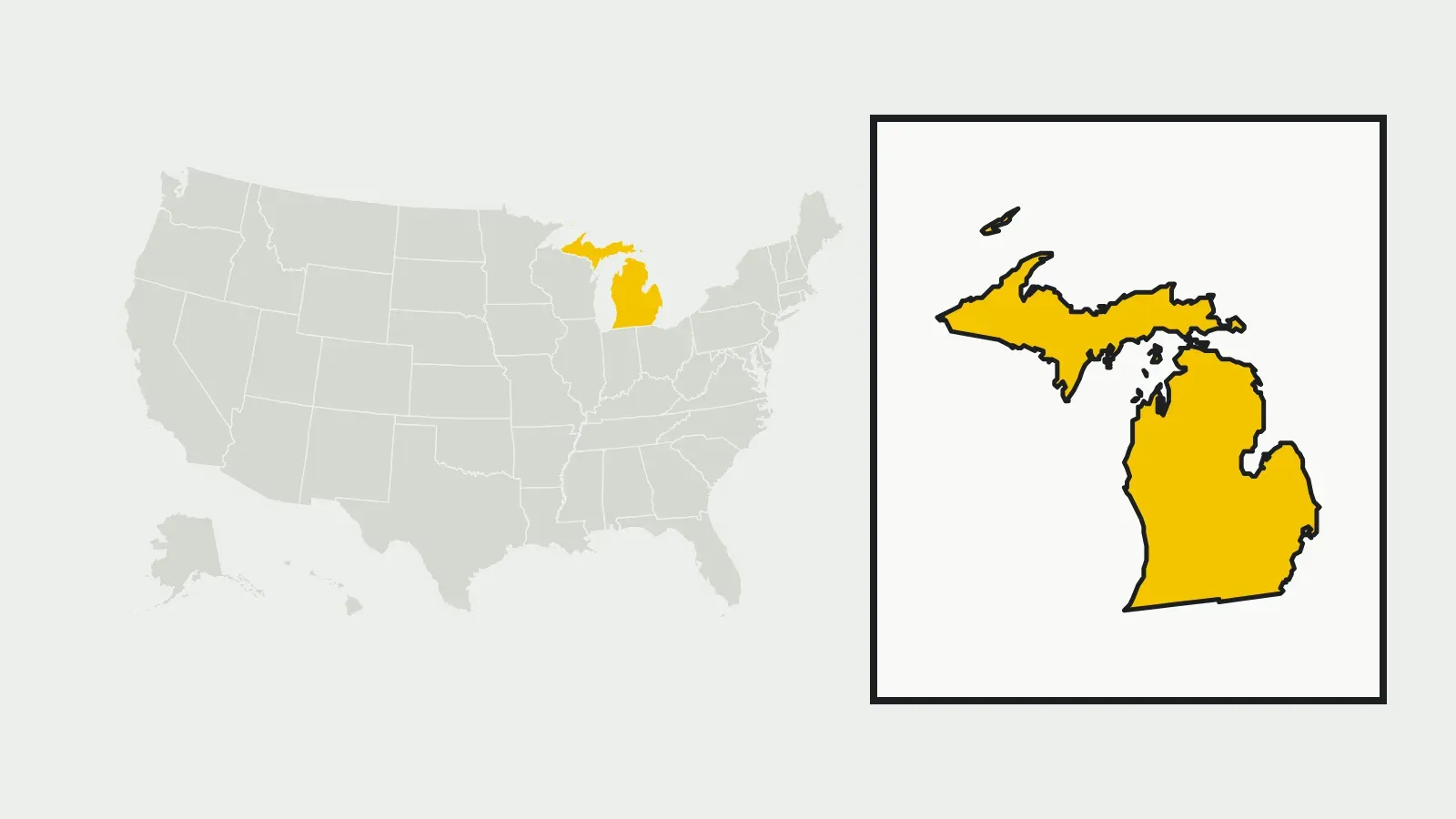
In short
Michigan requires a state license for residential builders and for residential maintenance and alteration contractors, the category for repairing or altering a house, so check the license before you compare bids. The state's home energy rebates run as MiHER and are open, but new income-qualified applications are paused in several regions as of November 19, 2026. Rooftop solar is not exempt from property tax, but the assessor may not count it as added value until the home is sold.
Michigan at a glance
Roofers: Michigan requires a state license
Michigan's Occupational Code requires a license for a residential maintenance and alteration contractor, defined as a person who, for a fee, does "the repair, alteration, or addition to" a residential structure. A re-roof is a repair or alteration of a house. The statute text we read does not use the word roofing, so confirm with the state licensing department that a roofer needs this license before you rely on it.
There is a dollar threshold. A person working on one project with an aggregate contract price for labor, materials and other items under $600 is exempt. That exemption does not apply if the job is part of a larger operation or if contracts are split into amounts under $600 to dodge the law. Owners working on their own occupied home are exempt too. Almost every roof job is far above $600, so ask for the license.
- Ask the roofer for the license type and number, and match the name on the license to the name on the contract.
- Ask for a certificate of insurance sent by the insurer, not a copy handed over by the roofer.
- Ask the city or township building office whether the re-roof needs a permit and who pulls it.
- Hold the final payment until the cleanup and any inspection are done.
Weatherization help for lower incomes
The Michigan Department of Health and Human Services (MDHHS) runs the Weatherization Assistance Program through its Bureau of Community Action and Economic Opportunity. Local subgrantees, mostly community action agencies, deliver the work. The most recent state plan we could open, for program year 2019, sets eligibility at or below 200% of the federal poverty guidelines, and a household also qualifies if a member received cash assistance (FIP) or SSI in the past 12 months.
You apply to a local agency, which uses a combined weatherization and energy assistance application. Expect to show income records, proof of ownership or tenancy, and Social Security numbers for everyone in the home. The MDHHS page we read did not list a current income table, so confirm the limit with the agency. See how weatherization and rebates work for what the work usually covers.
Home energy rebates: open, with pauses
The Michigan Department of Environment, Great Lakes, and Energy (EGLE) runs the federal HOMES and HEAR rebates as MiHER. EGLE's August 20, 2026 newsletter says the program rolled out in 2025 and is taking applications from low-to-moderate-income residents statewide, with a temporary pause in approvals in the Detroit district. EGLE's program page also lists new income-qualified applications as temporarily unavailable in the Detroit, Warren, Grand Rapids, Lansing and Kalamazoo districts, with no reopening date.
- HOMES: whole-home efficiency upgrades, with rebates based on modeled energy savings.
- HEAR: electric equipment such as heat pumps and water heaters, for households at or below 150% of area median income.
- Contractor: the work must be done by an approved MiHER Registered Contractor. The call center is 855-510-7080.
Check your own district on the EGLE page before you book work, and do not start a job you expect a rebate to cover until you have an award letter. We track changes on the rule changes page.
Solar and property tax
Michigan has no property tax exemption for a home's rooftop solar. It does have a rule that keeps the system from raising your assessment right away. Under MCL 211.27(2)(p), installing an alternative energy system on residential property counts as normal maintenance, not as an increase in value, if the system is not larger than 150 kilowatts and its annual output does not exceed what the home uses. The assessor does not count it "until the property is sold."
After a sale, the Treasury says the assessor may count the system's value, and Treasury Bulletin 6 of 2020 tells assessors to apply the rule whether or not the owner filed Form 865. A separate exemption certificate exists only for large solar facilities. The federal 25D credit ended for systems placed in service after December 31, 2025, so size a quote against your own rates with the solar payback calculator and read the rooftop solar page first.
Insulation targets in Michigan climate zones
Michigan counties fall in climate zones 5A, 6A and 7 in the 2021 IECC county guide from Pacific Northwest National Laboratory (PNNL). The southern Lower Peninsula is zone 5A, most other counties are 6A, and Keweenaw and Marquette counties are zone 7. The ENERGY STAR retrofit table gives the same attic targets for all three, so measure what you have with the attic insulation gap calculator.
| Michigan zone | Attic with none | Attic with 3-4 inches |
|---|---|---|
| 5A, 6A and 7 | R-60 | R-49 |
Common questions
Do I need a license to hire a roofer in Michigan?
Michigan requires a license for residential maintenance and alteration contractors, with an exemption for single jobs under $600. The statute does not name roofing, so ask the state licensing department to confirm, and ask the roofer for the license number.
Are the Michigan home energy rebates open?
Yes, under the name MiHER, run by EGLE. As of our November 19, 2026 check, new income-qualified applications were paused in the Detroit, Warren, Grand Rapids, Lansing and Kalamazoo districts.
Does rooftop solar raise my Michigan property tax?
Not right away. Under MCL 211.27(2)(p) the assessor does not count a qualifying system as added value until the property is sold, and after a sale it may count it.
What attic insulation does Michigan need?
ENERGY STAR recommends R-60 for an attic with none and R-49 for one with 3 to 4 inches in zones 5, 6 and 7, which cover Michigan.
Sources
- Michigan Legislature: MCL 339.2401, residential builder and maintenance and alteration contractor
- Michigan Legislature: MCL 339.2403, license exemptions and the $600 threshold
- MDHHS: Weatherization Assistance Program state plan, program year 2019
- EGLE: MiHER newsletter, August 20, 2026
- EGLE: Home energy rebate programs
- Michigan Treasury: Bulletin 6 of 2020, alternative energy systems
- ENERGY STAR: Recommended insulation levels for existing homes
- PNNL: Guide to determining climate zone by county, 2021 IECC
Facts checked on November 19, 2026 against the pages above. The EGLE newsletter is dated August 20, 2026. Programs and rules change; confirm with the agency before you act.
Next on the job
-
Project
Roof replacement
Tear-off, squares, ventilation and the questions to ask before you sign a bid.
-
Guide
Hire a licensed contractor
Check the license, the insurance and the permit plan before you sign. Licensing is state law.
-
Guide
How energy rebates and weatherization work
Federal credits ended in 2025. What the Weatherization program and state HOMES and HEEHR rebates do now.