License required
Montana: help with roof, insulation and solar work
Contractors need a state license as of January 1, 2026, the home energy rebates are waiting on federal approval, and the first $20,000 of solar value is exempt.
By RoofElm Editorial Team Updated 5 min read
- State roofer license
- License required
- Weatherization help
- Income up to 200% FPL
- HOMES and HEAR rebates
- Not open yet
- Solar property tax
- First $20,000 exempt
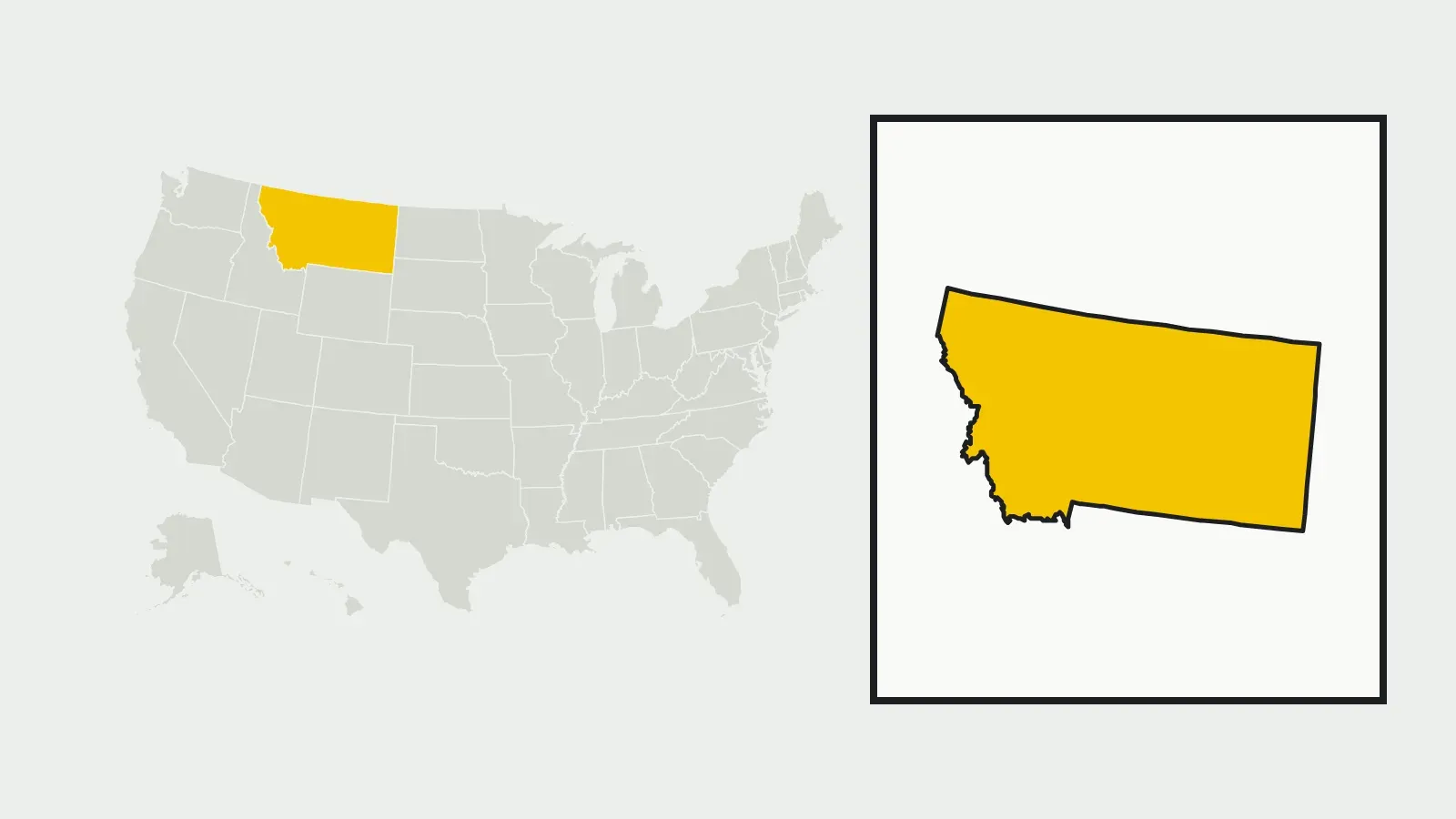
In short
Montana requires a construction contractor license from the Department of Labor and Industry, and the definition names roofing; the requirement took effect on January 1, 2026. The state's home energy rebates are not open and are waiting on final U.S. Department of Energy approval. A single-family home can exempt the first $20,000 of appraised value of a qualifying solar system for 10 years after installation, and households at or below 200% of the poverty level can apply for weatherization.
Montana at a glance
Roofers: a state license since 2026
Under Montana Code section 37-45-201, an individual or business entity may not work as a construction contractor without a current license. House Bill 239 of the 2025 session created the license, and the Department of Labor and Industry says it took effect on January 1, 2026. The definition of a construction contractor in section 37-45-102 includes "the installation or repair of roofing or siding." Contractors who held an active registration on December 31, 2025 were converted to the new license.
The law has exemptions, and several matter to a homeowner. Work on one project is exempt if the total contract price is under $2,500, unless it is part of a larger job or split to dodge the law. Owners working on their own home are exempt. Independent contractors with no employees are exempt too, but they may register voluntarily. A solo roofer without a license is therefore not automatically breaking the law, so ask.
- Ask for the license number, and ask whether the roofer has employees. Match the name to the contract.
- If the roofer says they are exempt, ask which exemption applies and why.
- Ask for a certificate of insurance from the insurer, and ask your city or county whether a re-roof needs a permit.
- Hold the final payment until the cleanup and any inspection are done.
The hiring guide has the full question list, and the roof replacement page shows what a bid should name.
Weatherization help for lower incomes
The Montana Department of Public Health and Human Services (DPHHS), through its Human and Community Services Division, runs the Weatherization Assistance Program. Households that qualify for the energy assistance program (LIHEAP) are also eligible for weatherization. The 2024-2025 weatherization limit is 200% of the poverty level, which DPHHS lists as $62,400 for a household of four, and the page notes that limits may have changed with the 2026-2027 application.
You can apply at any time at apply.mt.gov, through your local eligibility office or Tribal LIHEAP office, or with the combined LIHEAP and weatherization application. The page we read did not name the agencies that do the work, so ask the eligibility office who serves your county. See how weatherization and rebates work for what the work usually covers.
Home energy rebates: not open
The Department of Environmental Quality (DEQ) says the Montana Home Energy Rebates Program, covering the whole-home HOMES rebates and the high-efficiency electric home rebates (the HEAR side), "is not currently available." The state submitted its application to the U.S. Department of Energy in November 2024, and DEQ received conditional awards in January 2025 but cannot use the funds until DOE approves the application.
Planning work paused in February 2025 while DOE developed new guidance that may require changes to the application. On June 1, 2026, DOE issued an initial revised guidance overview, with more detail expected in the coming months. No launch date is set.
Solar and property tax
Montana Code section 15-6-224 exempts the appraised value of a capital investment in a recognized nonfossil form of energy generation for 10 years after installation, up to $20,000 for a single-family home and $100,000 for a multifamily or nonresidential building. The definition in section 15-32-102 starts with a system that uses solar energy, so rooftop solar is covered. The statute text we read describes no application step, so ask your county appraisal office how it applies the exemption.
The federal 25D credit ended for systems placed in service after December 31, 2025, which leaves this exemption as the main public break at the home level. Compare a quote against your own rate with the solar payback calculator, and read the rooftop solar page before you sign.
Insulation targets in Montana climate zones
In the 2021 IECC county guide from Pacific Northwest National Laboratory, every Montana county is zone 6B. The ENERGY STAR retrofit table gives R-60 for an attic with no insulation and R-49 for one that already has 3 to 4 inches. Measure what you have with the attic insulation gap calculator.
| Montana zone | Attic with none | Attic with 3-4 inches |
|---|---|---|
| 6B | R-60 | R-49 |
Common questions
Do I need a license to hire a roofer in Montana?
Since January 1, 2026, construction contractors need a state license from the Department of Labor and Industry, and the definition includes roofing. Exemptions include jobs under $2,500 and independent contractors with no employees.
Are the Montana HOMES and HEAR rebates open?
No. DEQ says the program is not currently available and is waiting on final DOE approval, with no launch date.
How much of my solar system is exempt from Montana property tax?
For a single-family home, the first $20,000 of appraised value of a qualifying system is exempt for 10 years after installation under section 15-6-224.
How do I apply for weatherization in Montana?
Apply online at apply.mt.gov, through your local eligibility office, or with the combined LIHEAP and weatherization application.
Sources
- Montana Code 37-45-104: Construction contractor exemptions
- Montana Department of Labor and Industry: Construction Contractor License program
- Montana DPHHS: Weatherization Assistance Program
- Montana DEQ: Energy efficiency programs and home energy rebates
- Montana Code 15-6-224: Nonfossil energy generation
- Montana Code 15-32-102: Definitions, recognized nonfossil forms of energy generation
- ENERGY STAR: Recommended insulation levels for existing homes
- PNNL: Guide to determining climate zone by county, 2021 IECC
Facts checked on November 19, 2026 against the pages above. The DEQ rebate page we read carries entries through June 1, 2026. Programs and rules change; confirm with the agency before you act.
Next on the job
-
Project
Roof replacement
Tear-off, squares, ventilation and the questions to ask before you sign a bid.
-
Guide
Hire a licensed contractor
Check the license, the insurance and the permit plan before you sign. Licensing is state law.
-
Guide
How energy rebates and weatherization work
Federal credits ended in 2025. What the Weatherization program and state HOMES and HEEHR rebates do now.