Roofer registration
Rhode Island: help with roof, insulation and solar work
Roofers must register with the state board, one home energy rebate is open to income-eligible households, and the solar tax break depends on your town.
By RoofElm Editorial Team Updated 5 min read
- State roofer license
- Registration required
- Weatherization help
- Local agencies
- HOMES and HEAR rebates
- HEAR open, HOMES not
- Solar property tax
- Your town decides
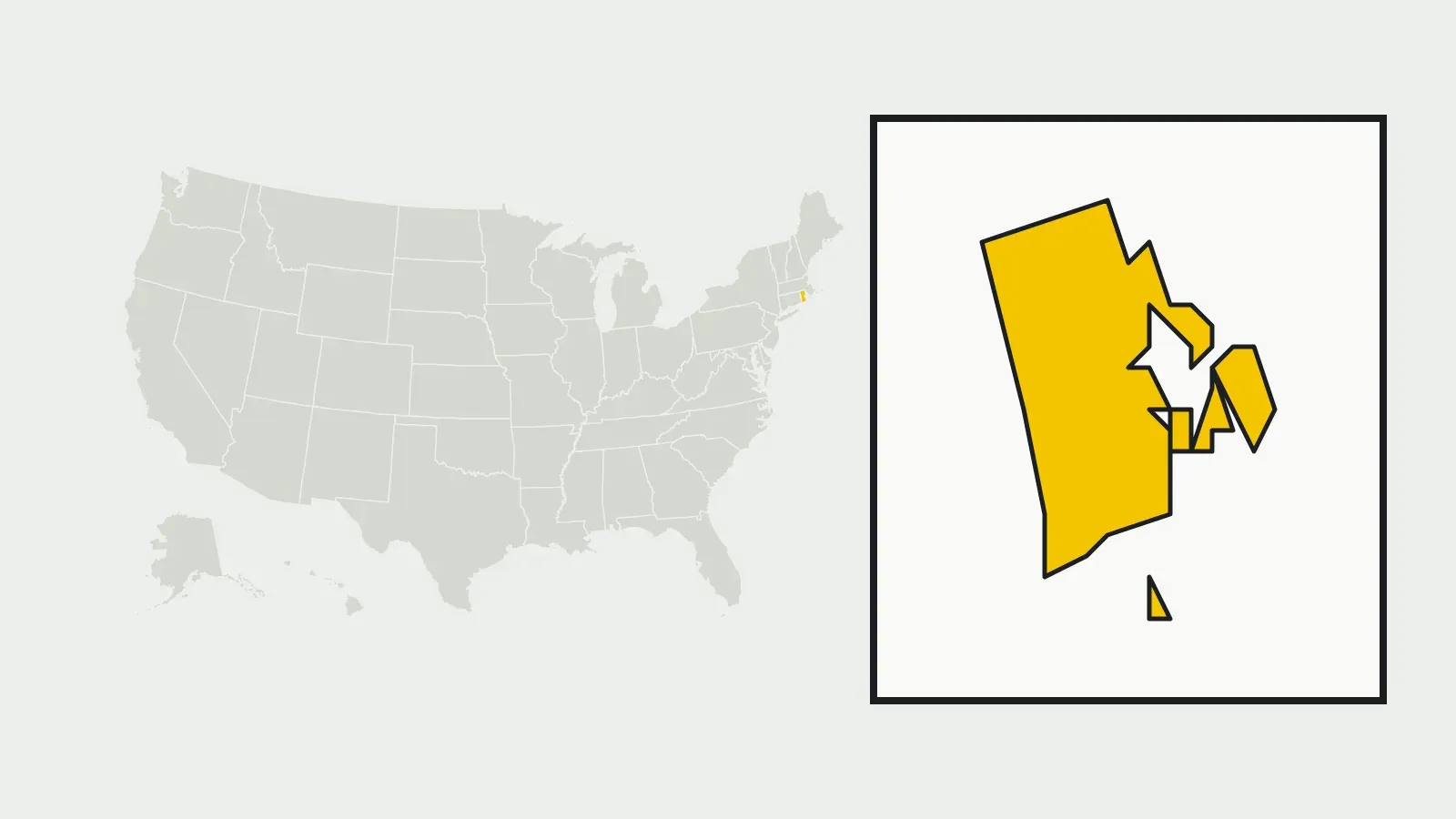
In short
Rhode Island makes residential roofers register with the Contractors' Registration and Licensing Board (CRLB), which requires a $500,000 liability insurance certificate. Of the two federal home energy rebates, HEAR is open to income-eligible households that apply and get approved before buying, while HOMES is waiting on U.S. Department of Energy approval. A solar tax exemption exists only if your city or town has passed an ordinance for it.
Rhode Island at a glance
Roofers: register with the CRLB
For a house, Rhode Island asks for registration, not a license. The CRLB's FAQ says every contractor and subcontractor in the business of building or repairing structures must register, and it lists a $500,000 certificate of liability insurance naming the board as certificate holder, plus a workers' compensation certificate if the contractor has employees. Workers paid on a 1099 count as subcontractors and must register too.
The licensing track is for commercial work. Under R.I. Gen. Laws chapter 5-73, a roofing license applies to commercial or industrial roofing on nonresidential buildings, and residential buildings of four dwelling units or fewer are excluded from it. A job under $500 on one contract is exempt if it is casual and minor, but anyone who advertises as a contractor must register regardless of size.
- Ask the roofer for the CRLB registration number and check it with the board before you sign.
- Ask for the insurance certificate and a copy of the workers' compensation certificate if there are employees.
- Ask your city or town building office whether a roof replacement needs a permit and who pulls it.
- Get at least two written estimates that name the shingle line, the underlayment and the flashing.
The guide to hiring a contractor has the full question list, and the roof replacement page shows what a good estimate contains.
Weatherization help for lower incomes
We have not confirmed which Rhode Island office runs the federal Weatherization Assistance Program, so we cannot name the agency or its exact income table. The federal program sets the limit at 200% of the federal poverty guidelines, states may set the exact table, and local agencies do the work and take the applications.
A concrete starting point: the Office of Energy Resources tells households enrolled in LIHEAP, the heating assistance program, to contact their local Community Action Program agency to schedule a home energy audit under the HEAR rebate. It is also a sensible first call about weatherization. See how weatherization and rebates work for what the work usually includes.
Home energy rebates: HEAR open, HOMES not
The Office of Energy Resources runs both federal rebates. The income-eligible pathway of HEAR, for appliances and electrification, launched September 17, 2024 for low- and moderate-income residents. You must apply and be pre-approved before you buy an eligible product or have electrical upgrades done. A retail pathway is running as a pilot in 11 listed municipalities, including Pawtucket, Newport and Jamestown. Questions go to Energy.HEAR@energy.ri.gov.
HOMES, which the state calls the Home Efficiency Rebates program, is not open: the application was accepted and is pending U.S. Department of Energy approval to launch. The state's HOMES page describes multifamily buildings of five or more units with at least half the units occupied by households under 80% of area median income, and a modeled energy saving of at least 20%. We track changes on the rule changes page.
Solar and property tax
Rhode Island has no automatic state exemption. R.I. Gen. Laws section 44-3-21 says a city or town council may, by ordinance, exempt a renewable energy system from taxation in its own municipality. If your town passed one, the exemption follows its terms. If it did not, this section gives you no exemption. Ask your local tax assessor whether an ordinance exists before you sign.
The federal 25D tax credit for rooftop solar ended for systems placed in service after December 31, 2025, so do not count on it for a 2026 install. Compare a quote against your own electric rate with the solar payback calculator, and read the rooftop solar project page before you sign.
Insulation targets and climate zones
Your county's International Energy Conservation Code (IECC) climate zone sets your attic target, so get the zone from your building office or the code's county table before you buy insulation. The ENERGY STAR retrofit table for existing homes gives these figures in its "Add Insulation to Attic" columns. Then measure what you have with the attic insulation gap calculator.
| IECC zone | Attic with none | Attic with 3-4 inches |
|---|---|---|
| 2 and 3 | R-49 | R-38 |
| 4A and 4B | R-60 | R-49 |
| 4C through 8 | R-60 | R-49 |
Common questions
Do I need a license to hire a roofer in Rhode Island?
For a house, the contractor needs to be registered with the CRLB, not licensed. The roofing license covers commercial and industrial roofing. Ask for the registration number and the insurance certificate.
Is the Rhode Island HEAR rebate open?
Yes, the income-eligible pathway has been open since September 17, 2024. You must apply and be pre-approved before you buy. The retail pathway is a pilot in 11 listed municipalities.
Is the Rhode Island HOMES rebate open?
Not as of November 19, 2026. The Office of Energy Resources says its application is pending U.S. Department of Energy approval to launch.
Does my solar system raise my Rhode Island property tax?
It depends on your town. State law lets a city or town council exempt renewable energy systems by ordinance, but it does not require it. Ask your local tax assessor.
Sources
- Rhode Island CRLB: Frequently asked questions
- Rhode Island CRLB: Commercial roofing license
- Rhode Island General Laws 5-73-1: roofing definitions
- Rhode Island General Laws 5-73-3: roofing contractor licensing
- Rhode Island Office of Energy Resources: Home energy rebate programs
- Rhode Island Office of Energy Resources: HEAR program
- Rhode Island Office of Energy Resources: HOMES program
- Rhode Island General Laws 44-3-21: renewable energy system exemption
Facts checked on November 19, 2026 against the pages above. Programs and rules change; confirm with the agency before you act.
Next on the job
-
Project
Roof replacement
Tear-off, squares, ventilation and the questions to ask before you sign a bid.
-
Guide
Hire a licensed contractor
Check the license, the insurance and the permit plan before you sign. Licensing is state law.
-
Guide
How energy rebates and weatherization work
Federal credits ended in 2025. What the Weatherization program and state HOMES and HEEHR rebates do now.