License required
Massachusetts: help with roof, insulation and solar work
Roofing takes two state credentials, the federal home energy rebates are planned but we could not confirm they are open, and small solar systems are exempt for 20 years.
By RoofElm Editorial Team Updated 6 min read
- State roofer license
- License required
- Weatherization help
- EOHLC; income not posted
- HOMES and HEAR rebates
- Planned, not confirmed
- Solar property tax
- 20-year exemption
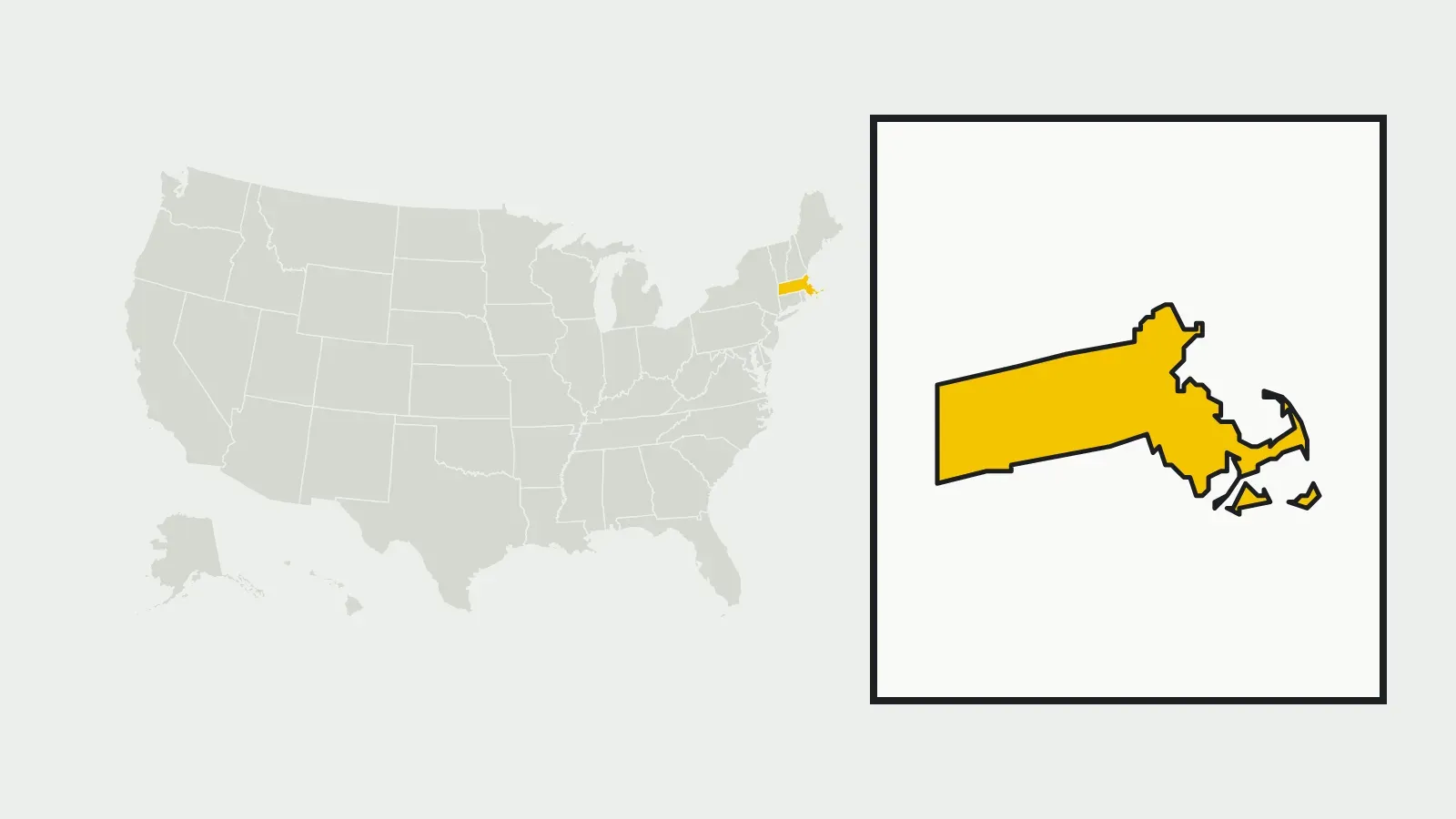
In short
Massachusetts requires two state credentials for a roof replacement: a Construction Supervisor License (the Roof Covering category is the minimum) and a Home Improvement Contractor registration for work on owner-occupied homes of one to four units. The federal home energy rebates have about $146 million set aside for the state, but we could not confirm that either program is open as of November 19, 2026. The Executive Office of Housing and Livable Communities runs weatherization, and a solar system that meets the size rules is exempt from property tax for 20 years under Chapter 59, section 5, clause 45.
Massachusetts at a glance
Roofers: a supervisor license and a registration
Two state credentials apply. The first is the Construction Supervisor License (CSL), set by the state building code, 780 CMR chapter R5. Anyone who directly supervises workers on construction, alteration or repair work regulated by the code generally needs one. Roof covering has its own category, RF, covering the construction, reconstruction, alteration, repair or removal of roof covering, and the state's contractor chart lists a roofing CSL as the minimum for roof replacement. A homeowner doing work that needs a building permit on their own home is exempt, and must then supervise any people they hire.
The second is the Home Improvement Contractor (HIC) registration from the Office of Consumer Affairs and Business Regulation. It is required for contractors who solicit, bid on or do work on existing owner-occupied, non-commercial property with one to four units. The state's chart marks both minor roof repairs and new or replacement roofing as needing HIC registration. The two are not interchangeable, so ask for both numbers. Building permits, contracts and advertising must show the contractor's active HIC number, and every building permit must state that people who hire unregistered contractors cannot use the Guaranty Fund. The guide to hiring a contractor lists the other questions, and the roof replacement project page shows what a good estimate contains.
- Ask the roofer for the HIC registration number and the name of the person on the crew who holds the CSL.
- Ask your building department whether the permit is in the contractor's name, since a roof replacement needs one.
- Get a written contract: state rules require one for residential work estimated at $1,000 or more.
- Limit any deposit to the greater of one-third of the price or the cost of special-order materials, and do not pay the final amount until the job is complete to your satisfaction.
Weatherization help for lower incomes
The Executive Office of Housing and Livable Communities (EOHLC) runs the Weatherization Assistance Program, which the state says is funded by the U.S. Department of Energy and provides full-scale home energy conservation services to eligible households. The Mass.gov pages we read do not state an income limit or describe a separate weatherization application, so we are not giving one.
The program page points to the general heating and energy assistance application. For help finding the right door, call Mass211 by dialing 2-1-1, or EOHLC at 617-573-1100, or write Housing.Help@mass.gov. See how weatherization and rebates work for what the work usually includes.
Home energy rebates: planned, status unconfirmed
The Department of Energy Resources (DOER) designs the state's federal rebate programs. Massachusetts received $73,086,125 for the whole-home rebates (HER, the program the federal government calls HOMES) and $72,809,130 for the appliance and electrification rebates (HEAR). DOER plans to deliver HEAR through Mass Save and HER through a program for municipal light plant customers and an expanded affordable housing program.
The DOER pages we read are old and undated. A DOER Q&A that appears to date from about February 2025 planned a HEAR launch in June 2025 and an HER launch for municipal light plant customers in July 2025, and warned that delays may occur. We found no later notice, so we cannot say either program is open. Check Mass Save and DOER before you buy because of a rebate. We track changes on the rule changes page.
Solar and property tax
General Laws chapter 59, section 5, clause 45 exempts an owned or leased solar-powered system from property tax for 20 years if it meets one of three conditions: it can produce no more than 125 percent of the annual electricity needs of the property, it is 25 kilowatts or less, or it has a payment-in-lieu-of-taxes agreement with the town. The clause does not apply to systems owned by electric or distribution companies. The text we read does not describe an application, so ask your local assessor how they apply it.
The federal 25D tax credit for rooftop solar ended for systems placed in service after December 31, 2025, so do not plan on it for a 2026 install. Compare a quote against your own electric rate with the solar payback calculator, and read the rooftop solar project page before you sign.
Insulation targets in Massachusetts climate zone
The Department of Energy county table puts every Massachusetts county in IECC climate zone 5A. For an existing attic, the Energy Star retrofit table recommends about R-60 if the attic has no insulation, and R-49 if it already has 3 to 4 inches. Measure what you have with the attic insulation gap calculator before you ask for bids.
| Massachusetts zone | Attic with none | Attic with 3-4 inches |
|---|---|---|
| 5A | R-60 | R-49 |
Common questions
Do I need a license to hire a roofer in Massachusetts?
Yes. Roofing needs a Construction Supervisor License, with Roof Covering as the minimum category, and a Home Improvement Contractor registration for work on owner-occupied homes of one to four units. Ask for both.
Does a Massachusetts roofing job need a written contract?
Yes, for residential work estimated at $1,000 or more. Any deposit cannot exceed the greater of one-third of the price or the cost of special-order materials.
Are the Massachusetts HOMES and HEAR rebates open?
We could not confirm that. DOER's pages are old and plan launches in 2025. Check Mass Save and DOER before you buy anything because of a rebate.
Does my solar system raise my Massachusetts property tax?
A qualifying system is exempt for 20 years under chapter 59, section 5, clause 45, if it is 25 kilowatts or less, sized to no more than 125 percent of the property's electricity use, or covered by a payment-in-lieu-of-taxes agreement.
Sources
- Mass.gov: Home improvement contractor (HIC) resources and work chart
- Mass.gov: 780 CMR R5, Construction supervisors
- Mass.gov EOHLC: Home energy assistance programs
- Mass.gov DOER: Federal funding updates and information
- Mass.gov DOER: 2025 town hall Q&A
- Massachusetts Legislature: General Laws chapter 59, section 5
- ENERGY STAR: Recommended insulation levels for existing homes
- U.S. Department of Energy: Building America climate region guide, county table
Facts checked on November 19, 2026 against the pages above. The DOER pages we read show no update dates, and the Q&A appears to date from about February 2025. Programs and rules change; confirm with the agency before you act.
Next on the job
-
Project
Roof replacement
Tear-off, squares, ventilation and the questions to ask before you sign a bid.
-
Guide
Hire a licensed contractor
Check the license, the insurance and the permit plan before you sign. Licensing is state law.
-
Guide
How energy rebates and weatherization work
Federal credits ended in 2025. What the Weatherization program and state HOMES and HEEHR rebates do now.