Contractor registration
Washington: help with roof, insulation and solar work
Roofers must register with L&I, weatherization runs through local agencies, and a state-funded heat pump rebate is available through local administrators.
By RoofElm Editorial Team Updated 5 min read
- State roofer license
- Registration required
- Weatherization help
- 200% FPL or 80% AMI
- HOMES and HEAR rebates
- Federal not found open
- Solar property tax
- No exemption found
In short
Washington requires every construction contractor to register with the Department of Labor & Industries (L&I), and roofing is one of the specialties, so working or bidding unregistered is a gross misdemeanor. The federal home energy rebates (HOMES and HEAR, now called HEEHR) were not found open as of November 19, 2026, but a separate state-funded HEAR program runs through local administrators. Weatherization is free if your income is within 200% of the federal poverty level, 60% of state median income, or 80% of area median income, and you apply through a local agency.
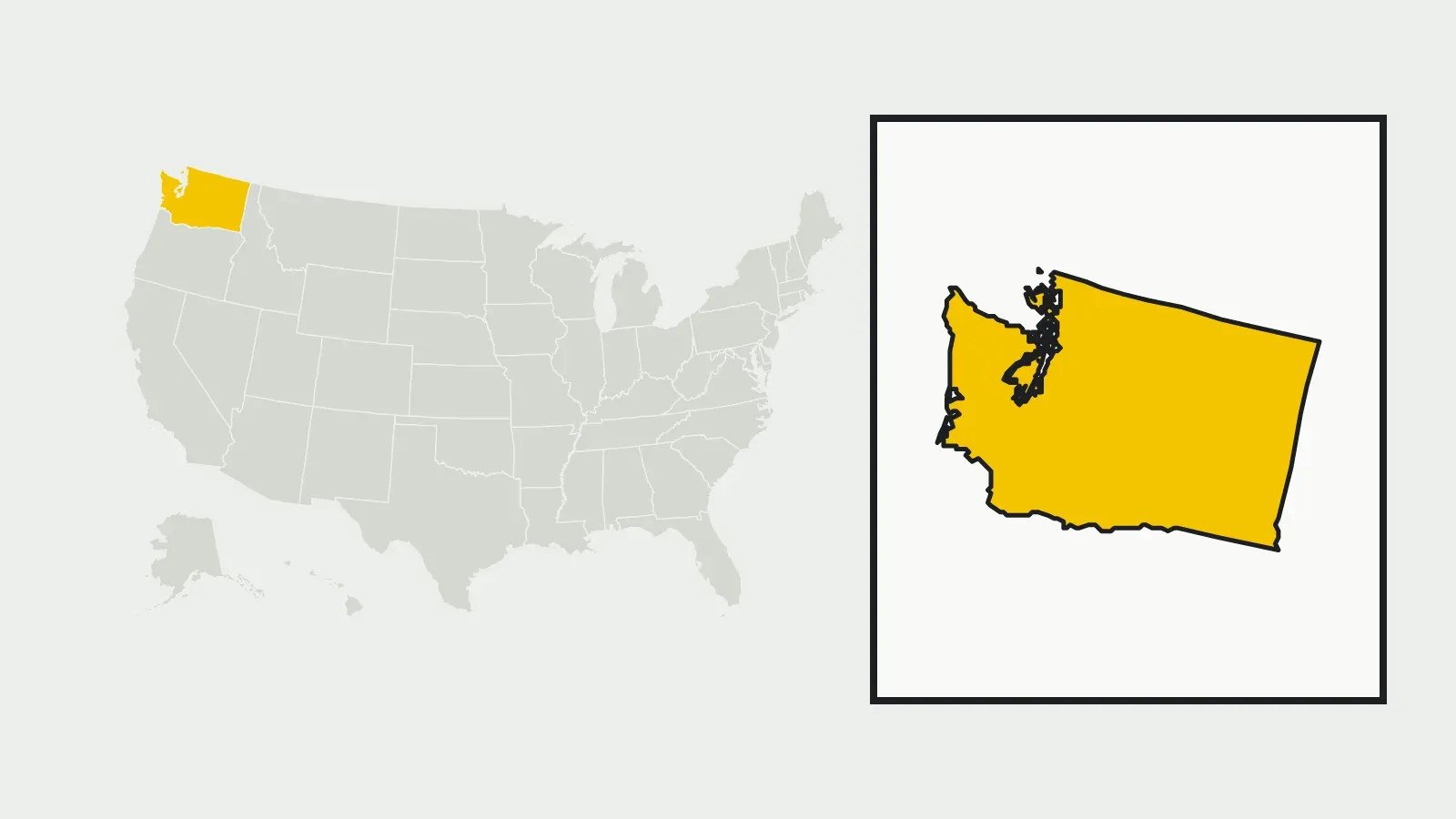
Washington at a glance
Roofers: registration with L&I
Washington does not call it a license, but the rule is strict. Under RCW 18.27.020, every contractor must register with L&I, and it is a gross misdemeanor to work, advertise or bid without registration, or to use an unregistered contractor as a subcontractor. L&I registers general contractors and specialty contractors. Roofing is one of 63 regulated specialties, and a specialty contractor can work only in the specialty it is registered for.
- Bond: a $15,000 continuous surety bond for a specialty contractor, $30,000 for a general contractor. Bond amounts rose on July 1, 2024.
- Insurance: general liability of $200,000 public liability plus $50,000 property damage, or a $250,000 combined single limit, with L&I as certificate holder.
- Registration fee: $150.20 for the application.
You can check a registration on the L&I contractor lookup. We did not read the chapter's exemptions, so ask L&I if the contractor says the job is exempt. The guide to hiring a contractor has the full list of questions.
- Ask for the Washington contractor registration number and check it with L&I, including the bond and insurance.
- Ask your city or county whether the roof job needs a permit. See permits and inspections.
- Put the scope, shingle line and payment schedule in a written contract, and see the roof replacement project page for what a good bid contains.
Weatherization help for lower incomes
The Washington Department of Commerce funds local agencies that make energy efficiency repairs for qualified homeowners and renters. Commerce does not take applications. You contact your local agency, which checks your income and enrolls you. You may qualify if your household income is within any one of three limits.
- 200% of the federal poverty level
- 60% of the state median income
- 80% of the area median income
Work can include insulation, air sealing, ventilation and safety detectors. The program is not a window replacement program, and some agencies keep waitlists. A 2026 law, House Bill 2338, creates a way to fund weatherization for many homes in one neighborhood, and Commerce's rulemaking was still open in November 2026. See how weatherization and rebates work.
Home energy rebates: federal not open, state HEAR local
Commerce posted in July 2024 that DOE had awarded $84.9 million for the federal HEAR rebates and was still reviewing Washington's application for the whole-home HOMES rebates. We found no newer notice that either federal program has opened, so treat them as not open as of November 19, 2026.
Separately, Commerce runs a state-funded HEAR program paid for with Climate Commitment Act money. Rebates for heat pumps, heat pump water heaters, induction cooking and related electrical work go through local administrators, and availability differs by area. Households at or below 150% of area median income can qualify, and administrators may set their own criteria, so ask the one that covers your county. We track the federal programs on the rule changes page.
Solar and property tax
The Washington property tax exemptions chapter, 84.36 RCW, has one renewable energy exemption that we found, RCW 84.36.680, and it covers the state portion of personal property tax for solar or wind facilities of at least 10 megawatts. A home rooftop system is far smaller, so it does not qualify. We did not find a state exemption for residential rooftop solar, so ask your county assessor how a system is valued on your home.
The federal 25D tax credit for rooftop solar ended for systems placed in service after December 31, 2025, so there is no federal credit to count on for a 2026 install. Compare a quote against your own electric rate with the solar payback calculator, and read the rooftop solar project page before you sign.
Insulation targets in Washington climate zones
A federal Building America county guide splits Washington into four zones. Zone 4C covers 18 counties, including King, Pierce, Snohomish and Clark. Zone 5B covers 17 counties, including Spokane, and Yakima County is 5C. Ferry, Okanogan and Pend Oreille are zone 6B. For an existing attic, the ENERGY STAR retrofit table gives about R-60 if the attic has no insulation and R-49 if it already has 3 to 4 inches. Measure what you have with the attic insulation gap calculator.
| Washington zone | Uninsulated attic | Attic with 3-4 inches |
|---|---|---|
| 4C, 5B, 5C | R-60 | R-49 |
| 6B | R-60 | R-49 |
Common questions
Do I need a license to hire a roofer in Washington?
You need to check for registration. Washington requires construction contractors, including roofers, to register with L&I, and carry a bond and insurance. Working or bidding unregistered is a gross misdemeanor.
Who qualifies for weatherization in Washington?
Households within 200% of the federal poverty level, 60% of state median income, or 80% of area median income. Contact your local weatherization agency, because Commerce does not take applications.
Are the Washington HOMES and HEAR rebates open?
We found no sign that the federal programs have opened as of November 19, 2026. A separate state-funded HEAR program runs through local administrators, so ask the one that covers your county.
Does my solar system raise my Washington property tax?
We found no state exemption for residential rooftop solar. The state exemption in RCW 84.36.680 is for facilities of at least 10 megawatts. Ask your county assessor.
Sources
- Washington L&I: Contractor registration
- RCW 18.27.020: Registration required
- Washington Commerce: Weatherization program
- Washington Commerce: Home Energy Rebate program receives funding from DOE (July 2024)
- Washington Commerce: State Home Electrification and Appliance Rebates (HEAR)
- Washington Department of Revenue: Renewable energy generation or storage facilities
- Chapter 84.36 RCW: Exemptions
- DOE Building America: Guide to determining climate regions by county
Facts checked on November 19, 2026 against the pages above. The newest federal rebate notice we could read is dated July 2024. Programs and rules change; confirm with the agency before you act.
Next on the job
-
Project
Roof replacement
Tear-off, squares, ventilation and the questions to ask before you sign a bid.
-
Guide
Hire a licensed contractor
Check the license, the insurance and the permit plan before you sign. Licensing is state law.
-
Guide
How energy rebates and weatherization work
Federal credits ended in 2025. What the Weatherization program and state HOMES and HEEHR rebates do now.