License at $40,000
North Carolina: help with roof, insulation and solar work
A state contractor license applies once a job reaches $40,000, home energy rebates are opening county by county, and solar equipment gets a property tax break.
By RoofElm Editorial Team Updated 6 min read
- State roofer license
- License at $40,000+
- Weatherization help
- Income-based, via DEQ
- HOMES and HEAR rebates
- Open in some counties
- Solar property tax
- 80% of value excluded
In short
North Carolina requires a general contractor license for work costing $40,000 or more, issued by the Licensing Board for General Contractors; below that amount the statute sets no state license. We could not confirm how the board treats a roofing-only job. The state's Energy Saver North Carolina rebates (HOMES and HEAR) launched January 16, 2025 and are opening county by county. A state tax rule excludes 80% of the appraised value of a solar electric system from property tax.
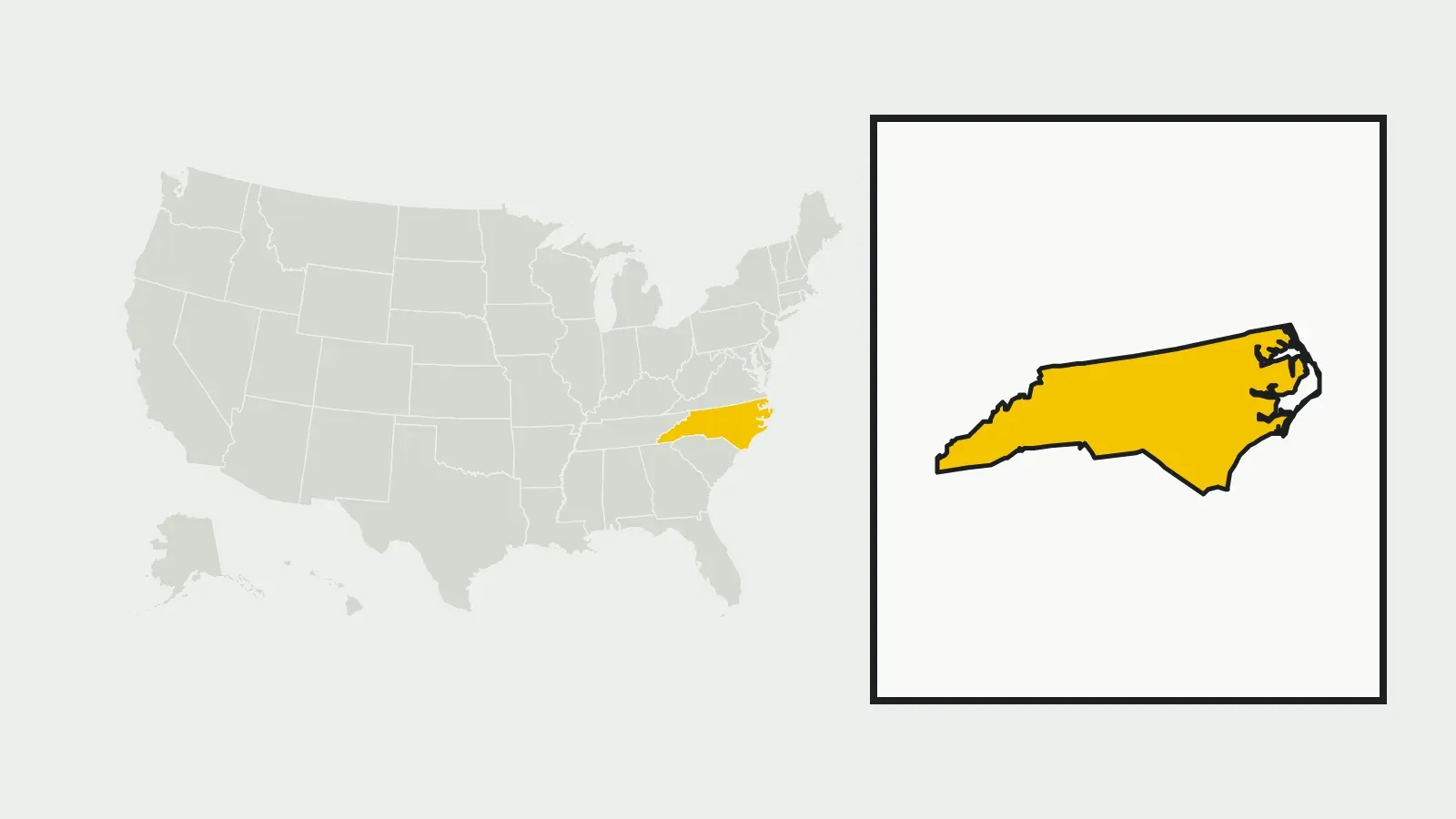
North Carolina at a glance
Roofers: a state license above $40,000
The North Carolina Licensing Board for General Contractors licenses general contractors. Under G.S. 87-1, a person who bids on or builds work where "the cost of the undertaking is forty thousand dollars ($40,000) or more" is a general contractor and needs a license. Licenses come in building, residential, highway, public utilities and specialty classes (G.S. 87-10). Neither section names roofing, and we did not confirm how the board treats a roofing-only job, so ask the board before you rely on that. An owner who builds or alters a home on their own land for their own occupancy is exempt.
Below $40,000 the statute sets no state license, so for many re-roofs the checking is yours. For a job at or above that amount, ask for the license number and classification and confirm them with the board. When a building permit applies to a job of $40,000 or more, the applicant must also name a lien agent (G.S. 87-14); contracts, warranties and lien waivers explains what that means for you.
- Ask the roofer what the total contract price is, and whether it reaches $40,000.
- If it does, ask for the general contractor license number and classification, and confirm them with the board.
- Ask your town or county building office whether a roof replacement needs a permit. See permits and inspections.
- Ask for a certificate of insurance sent by the insurer, and get written estimates that name the shingle brand and the underlayment. The roof replacement project page shows what a good one contains.
Weatherization help for lower incomes
The North Carolina Department of Environmental Quality (DEQ) runs the Weatherization Assistance Program through its State Energy Office, with local weatherization agencies doing the work. Most of the money is from the U.S. Department of Energy, and the Infrastructure Investment and Jobs Act added $89 million that is available through 2029. The program serves income-eligible households and gives priority to the elderly, people with disabilities, families with children, high energy users and energy-burdened households.
You apply through a local provider, which you can find with the Find Your Agency tool at weatherizenc.org. The provider reviews your application, does a home energy assessment, installs the approved measures and finishes with an inspection. DEQ's page does not give the income limit, so ask the provider for the current one. See how weatherization and rebates work for what the work usually includes.
Home energy rebates: opening by county
DEQ runs the federal home energy rebates as Energy Saver North Carolina. The program launched January 16, 2025 and is expected to run until 2031 or until the money is gone. It opens in phases by county: DEQ's page labels Phase 1, Cleveland and Halifax counties, as currently active, and lists Phases 2 through 7, from May 2025 to January 2026 and including Wake and Mecklenburg, without a status. Funds go first come, first served once a region is available.
| Item | What the page says |
|---|---|
| Who qualifies | Homeowners, multifamily owners and tenants with the owner's permission; below 80% of area median income are prioritized, 80% to 150% get lower rebates, above 150% are not eligible |
| HOMES cap | Up to $16,000 per home, with at least 20% energy savings from the work |
| HEAR cap | Up to $14,000 per home, ENERGY STAR appliances, registered contractor installs |
| How to apply | Online at energysavernc.org, or by mail; you can gather documents before your county opens |
DEQ's page says the U.S. Department of Energy issued updated Home Energy Rebates guidance on May 29, 2026 that affects the program, and it links a Program Changes page we did not read. Check that page before you start work, because HEAR does not pay rebates after the fact. We track this on the rule changes page.
Solar and property tax
North Carolina excludes 80% of the appraised value of a solar energy electric system from property tax. G.S. 105-275(45) defines the system as all equipment used directly and exclusively to convert solar energy to electricity. The statute text does not say how the exclusion is claimed, so ask your county tax office whether you must file. We did not confirm a rule for solar heating or cooling equipment.
The federal 25D tax credit for rooftop solar ended for systems placed in service after December 31, 2025. Check a quote with the solar payback calculator and read the rooftop solar project page before you sign.
Insulation targets in North Carolina climate zones
North Carolina counties fall in energy code climate zones 3A, 4A and 5A, according to the Department of Energy's county guide. ENERGY STAR's retrofit table recommends R-49 for an attic with no insulation and R-38 for one with 3 to 4 inches in zone 3, and R-60 and R-49 in zones 4 and 5. Measure what you have with the attic insulation gap calculator.
| Zone | Counties | Attic with none | Attic with 3-4 inches |
|---|---|---|---|
| 3A | 46 counties, including Mecklenburg, Cumberland, New Hanover and Pitt | R-49 | R-38 |
| 4A | 48 counties, including Wake, Guilford, Forsyth, Durham and Buncombe | R-60 | R-49 |
| 5A | Alleghany, Ashe, Avery, Mitchell, Watauga, Yancey | R-60 | R-49 |
Common questions
Do I need a license to hire a roofer in North Carolina?
A general contractor license is required when the cost of the undertaking is $40,000 or more. Roofing is not named in the statute, so ask the Licensing Board for General Contractors about your job, and always ask for proof of insurance.
Are the North Carolina HOMES and HEAR rebates open?
In some counties. Energy Saver North Carolina launched January 16, 2025 and opens by county, with Cleveland and Halifax labeled active on the DEQ page we read. Apply at energysavernc.org even if your county is not active yet.
Does my solar system raise my North Carolina property tax?
G.S. 105-275(45) excludes 80% of the appraised value of a solar energy electric system, so only the rest counts. Ask your county tax office how to claim it.
Who qualifies for North Carolina weatherization?
Income-eligible households, with priority for the elderly, people with disabilities, families with children and high energy users. Find your local agency at weatherizenc.org and ask for the current income limit.
Sources
- North Carolina General Statutes 87-1, Definitions (general contractor)
- North Carolina General Statutes Chapter 87, Article 1: General Contractors
- NC Licensing Board for General Contractors
- NC DEQ State Energy Office: Weatherization Assistance Program
- NC DEQ State Energy Office: Energy Saver North Carolina
- North Carolina General Statutes 105-275, Property classified and excluded from tax
- U.S. Department of Energy: Guide to determining climate regions by county
- ENERGY STAR: Recommended home insulation R-values
Facts checked on November 19, 2026 against the pages above. The DEQ rebate page's impact dashboard runs through June 30, 2026. The county climate table is from a 2015 Department of Energy guide. Programs and rules change; confirm with the agency before you act.
Next on the job
-
Project
Roof replacement
Tear-off, squares, ventilation and the questions to ask before you sign a bid.
-
Guide
Hire a licensed contractor
Check the license, the insurance and the permit plan before you sign. Licensing is state law.
-
Guide
How energy rebates and weatherization work
Federal credits ended in 2025. What the Weatherization program and state HOMES and HEEHR rebates do now.